2026 Ohio, Indiana, Illinois, and Missouri Weed Control Guide
Ohio State; Purdue; Illinois; Missouri
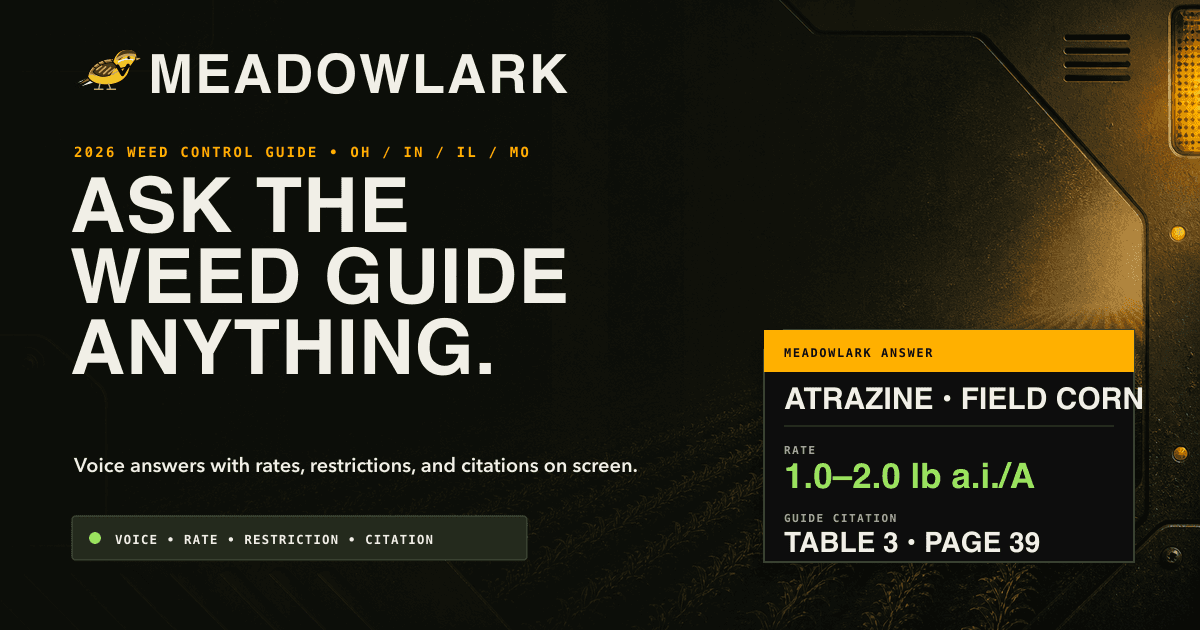
The field guide that talks back
How Meadowlark works
We turn regional crop-protection guides into voice answers you can verify on screen.
Ask Meadowlark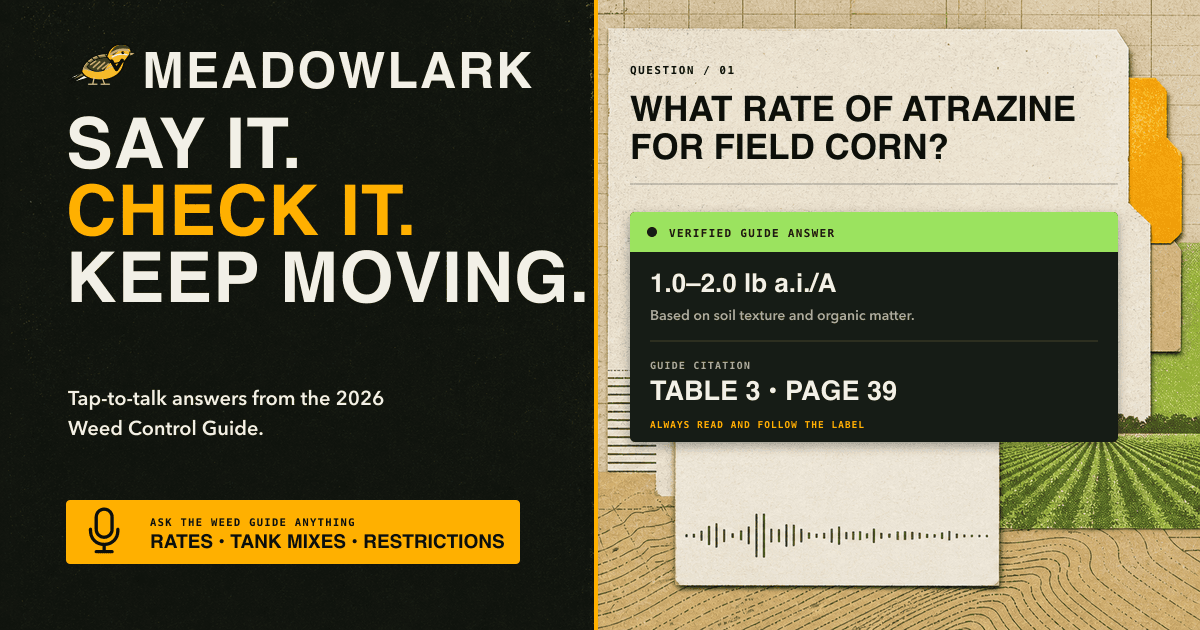
The 12 guides below cover 14 states and provinces. Each one is registered for retrieval, routing, and citations, and edition cautions stay visible where the latest available source is older.
Ohio State; Purdue; Illinois; Missouri
North Dakota State University Extension
Kansas State University Research and Extension
University of Arkansas System Division of Agriculture
Mississippi State University Extension
NC State Extension
University of Kentucky Cooperative Extension
Michigan State University Extension
University of Wisconsin-Madison Division of Extension
latest openly available edition
Manitoba Agriculture
Ontario Ministry of Agriculture, Food and Agribusiness
2017 edition : product registrations have likely changed; verify current registrations
Ontario Ministry of Agriculture; University of Guelph authors
Each guide is mapped, extracted, and indexed with the source details needed to trace an answer back.
PDF pages become high-resolution images and text layers. The Ontario weed ID guide is collected directly from its HTML.
Pages are classified by content type and grouped into crop chapters, reference sections, tables, and narrative.
Tables are read from page images while narrative uses the text layer. Guide, printed page, crop, and section stay attached.
Clean excerpts are tagged with products, weeds, crops, tables, and pages, then embedded and loaded into a hybrid search index.
Most PDFs follow an automated classification and document-map workflow. The multi-state pilot uses a manually checked map, and Michigan's chapter PDFs share one logical page space.
Vision extraction handles dense tables. Narrative extraction cleans the text layer without adding facts. Ontario's weed ID HTML does not need vision extraction.
Each indexed chunk keeps its guide, printed page, table number, crop, products, and weeds so retrieval and citations use the same provenance.
The voice agent moves quickly, but the source and safety checks stay in the loop.
The recording becomes a transcript. Conversation history, crop names, products, weeds, and any stated region are resolved into one clear query.
Meadowlark searches the guide for the selected region first. Any outside-region fallback is kept separate and clearly attributed.
An answer is drafted only from retrieved excerpts, checked for support, cited on screen, and then prepared for spoken playback.
Vector and keyword results are combined. Region coverage from the guide registry restricts search first, while thin results may be topped up with clearly attributed outside-region material.
Deterministic checks reject unsupported numbers, thresholds, product identities, citations, and drift between the spoken and on-screen answer. A separate verifier can approve or correct the draft.
Speech is generated only after the checked answer is ready. The recording is processed for transcription, and the conversation record is logged to improve reliability.
A candidate answer strategy must clear accuracy gates with zero fabricated rates and zero source misattributions before it can replace the current strategy.
Known questions protect answer quality as the retrieval and response pipeline changes.
Regional questions must use the right guide and identify any fallback without blending sources.
Fact questions are pinned to an exact source chunk, page, and required source wording.
Meadowlark never blends rates or restrictions across guides. If a regional guide is unavailable, the answer names any fallback source and asks you to verify locally. If the retrieved material cannot support an answer, Meadowlark withholds it.
Use Meadowlark to get oriented. Always read and follow the current product label before making an application.
Ask Meadowlark